Data & Analytics
Is Ecommerce Analytics Consulting Worth It, or Are You Buying a Deck That Goes Stale?
Consulting is worth it when the work is genuinely one-time, and stops being worth it the moment you need the same answer next month. An honest three-way comparison.
- Published
- Author
- AccessFuel Team
- Reading time
- 4 min read
It's worth it when the work is genuinely one-time. It stops being worth it the moment you need the same answer again next month.
That's the real risk with analytics consulting. You can buy a smart deck, a clean segmentation model, and a useful set of recommendations, then watch them start aging the day customers keep behaving.
A senior customer data analyst is a six-figure hire, and the job description most DTC brands would need to write is longer than the budget allows.
SQL and a modelled warehouse. Shopify, Klaviyo, GA4 and Meta unified at row level. Cohort, RFM and churn modelling. Attribution you can defend to the board. Reporting that lands before the Monday call. Available nights, weekends and holidays.
Most brands doing $2M to $15M never make that hire. So the work goes to a consultant, or it doesn't get done.
This is the honest version, from a company that sells the third option.
What ecommerce analytics consulting actually buys you
A good analytics consultant does three things well, and they're worth paying for.
First, they tell you which questions are worth asking. Most brands measure what their tools happen to report instead of what actually drives the business. An outside read can fix that faster than another internal debate.
Second, they build the measurement plan: the definitions, the events, and the one place revenue is allowed to be calculated. It's unglamorous work. It's also the difference between reports you trust and reports you argue about.
Third, they bring pattern recognition from other brands. Someone who's seen forty Shopify stores knows what a normal repeat rate looks like in your category. You don't, because you've seen one.
Where consulting stops being the right spend
Consulting is a project. Analysis is continuous.
A consultant delivers a segmentation model in six weeks and hands it over. Six weeks after that, the segments are stale because customers kept behaving. Nobody re-scores them because the person who knew how has moved on to another client.
The pattern is common enough to be predictable: strong deliverable, useful first few weeks, then decay. You didn't buy the wrong thing. You bought a project for a problem that keeps moving.
The second limit is speed. If a question has to become a scoped request before it gets answered, you'll stop asking the small ones. The small ones are where most of the money is.
The three-way comparison, honestly
| Consultant | In-house analyst | Customer intelligence platform | |
|---|---|---|---|
| Cost shape | Project fee | Salary and benefits | Subscription |
| Best at | Strategy, measurement plan, benchmarks | Deep context on your business | Continuous re-computation |
| Weakest at | Continuity after handover | Cost at this revenue band | Judgement calls and strategy |
| Answer speed | Days to weeks | Hours to days | Seconds |
| Right when | You need a plan built once | You're past $25M | You need the same questions answered every week |
That last row is the whole decision.
If the work is genuinely one-time, like a migration, a measurement rebuild, or a board deck, hire the consultant. It's the correct spend. Software won't do it for you.
What the software option covers
AccessFuel connects your data sources into one customer intelligence layer, then handles the repeat work that usually falls on a data hire.
Unify. Orders, clicks, campaigns, and customer records can be brought into one working view of the business.
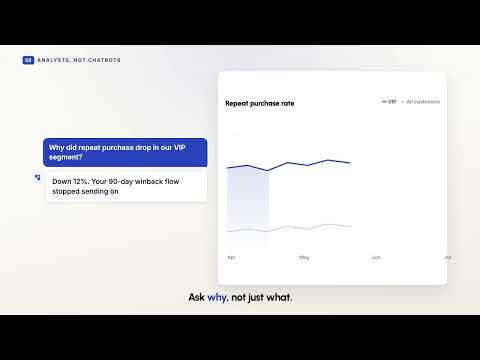
Analyse. Ask why repeat purchase dropped in a segment and get back the answer, the chart, and the supporting data.
Watch. AIRA can monitor for changes so the team sees what moved before the Monday call, not after it.
Activate. A finding can become a Customer Persona or segment the team can use for the next move.
What it doesn't do is decide your strategy for you. It can find the at-risk cohort and help draft the win-back. Deciding whether winning them back is a better use of the quarter than launching the new line is still your call, and a good consultant is genuinely useful for that.
How to choose in one question
Ask how often you want the answer.
Once, and you should hire the consultant.
Every week, and you need an always-on customer intelligence layer.
Every day, across a business past roughly $25M, and you should make the hire. At that point, the salary can be cheaper than the alternatives, and the context is worth owning.
Most brands in the $2M to $15M band answer "every week" and then buy a project. That's why the segmentation deck from last spring is still sitting in a folder.
See what AIRA answers
Watch AIRA take a question, show its working, and turn the answer into a Customer Persona your team can use.
Sixty seconds. No call required.
Related posts
Keep Exploring
Discover more insights, strategies, and updates from AccessFuel.
4 min read
Customer IntelligenceWhy Does One Buyer Look Like Five People?
One customer, five systems, five different versions of her. Customer data integration is what turns those blind systems into one that can see, and getting it wrong breaks everything downstream.

4 min read
Customer IntelligenceCustomer Intelligence: Why Can't 30 Tools Answer One Simple Question?
Most ecommerce brands run 30 or more tools and still cannot say why repeat purchases dropped last month. Customer intelligence is the layer that closes the gap between them.
5 min read
Customer IntelligenceCustomer Segmentation: Which of Your Loyalists Are About to Leave?
About one in five of your loyal customers are quietly slowing down. Shopify can confirm they exist. It will not tell you which ones are worth saving. RFM segmentation does.