Customer Intelligence
The Unfortunate Truth About Your “Personas”
Living Customer Personas turn real purchase behavior into insights your team can actually use. Anything else falls flat. Most "personas" sound useful until you try to activate them. “Sarah, 34. Loves fitness. Shops…
- Published
- Author
- AccessFuel Team
- Reading time
- 5 min read
Living Customer Personas turn real purchase behavior into insights your team can actually use. Anything else falls flat.
Most "personas" sound useful until you try to activate them.
“Sarah, 34. Loves fitness. Shops online. Prefers Instagram.”
Okay. Now what?
Which products should Sarah see first? What message will actually land? Is she motivated by convenience, quality, identity, price, trust, novelty, or something else entirely? Should the team reach her through email, SMS, push, paid social, or a mix?
Most personas don’t answer those questions because they were never built to. They’re often created in a workshop, polished into a deck, and treated like strategy.
But strategy shouldn’t start with a made-up person.
It should start with behavior.
That’s the idea behind Living Customer Personas: customer profiles built from real purchase data, connected to the way your audience actually buys, and designed to move straight into action inside AIRA.
Why the old persona model breaks
Traditional personas usually fail for three reasons.
First, they’re invented more than observed. They rely on demographics, adjectives, and broad assumptions. That can be directionally interesting, but it doesn’t tell your team what to do next.
Second, they go stale. Your customers change constantly. Their buying patterns shift. Their product preferences evolve. Their engagement changes. The PDF doesn’t.
Third, they’re disconnected from the work. Even a decent persona loses value if it lives outside the tools where campaigns, emails, ads, and briefs are actually created.
So the team does what teams do when insight isn’t easy to use.
They move on without it.
What a real persona looks like
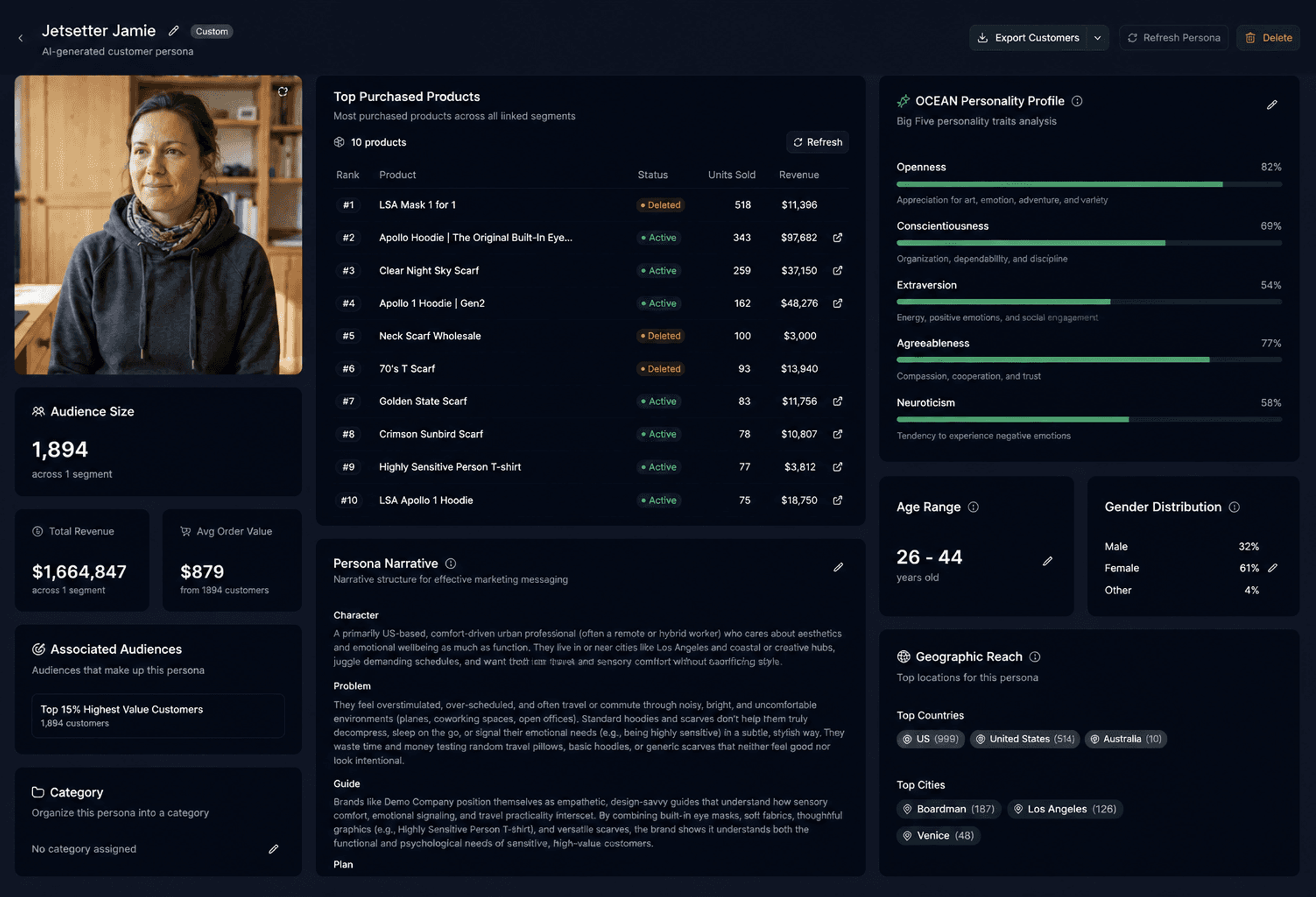
In this video, one of the personas is Jetsetter Jamie
She starts where every useful persona should start: with a real customer segment.
Jetsetter Jamie represents the top 15% of customers by lifetime spend.
That means the profile is anchored in a group of actual customers, not a creative guess.
1,284 real customers.
$1.66M in revenue.
$879 average order value.
From there, AIRA builds a fuller picture of the audience.
You can see OCEAN personality scores, including Openness, Conscientiousness, Extraversion, Agreeableness, and Neuroticism. That matters because good messaging isn’t just about what someone bought. It’s about how they’re likely to make decisions, what kind of language they respond to, and what they may need to feel confident enough to buy again.
You can also see what this audience actually purchases, which gives your team something practical right away: hero products, product angles, merchandising cues, and offer direction based on what the audience already values.
Then comes channel behavior.
For this persona, email and SMS show up as stronger channels than push. That’s a small detail with a big impact. It helps the team stop spreading every message everywhere and start building around where the audience is already more responsive.
The profile also includes goals, hopes, and pain points inferred from behavior. For Jetsetter Jamie, that includes ideas like wanting work, travel, and rest to feel more integrated, reducing post-travel burnout, and replacing fast-fashion impulse buys with more values-aligned pieces.
That’s where the persona becomes more than a segment.
It starts to feel like a real customer mindset, but without drifting into fiction.
The most useful part: what to do next
A persona shouldn’t just describe an audience.
It should help your team make better marketing decisions.
That’s why AIRA includes recommendations for targeting strategy, hero products, brand messaging, and channel mix. The point isn’t to admire the profile. The point is to use it.
So instead of asking, “Who is this customer?” and stopping there, your team can move into sharper questions:
What should we lead with?
Which products belong in the campaign?
What message is most likely to resonate?
Which channels should carry the weight?
How should this audience shape the creative brief?
That’s the difference between a persona as documentation and a persona as customer intelligence.
Why “living” matters
The word “living” isn’t decoration.
It’s the whole point.
A static persona reflects a moment in time. A living persona changes as customer behavior changes.
That matters for growing brands because your best customer today may not behave exactly like your best customer six months from now. New products change buying patterns. Promotions shift behavior. Seasonality changes intent. Retention patterns reveal new opportunities.
Your customer intelligence should keep up.
We’ve built personas this way for over a decade, using a patented methodology designed to turn customer behavior into practical marketing direction.
The goal isn’t another research artifact.
The goal is clarity your team can actually act on.
From persona to campaign with AIRA
This is where the workflow gets especially powerful.
Inside AIRA, you can type @persona and bring that full customer profile into whatever you’re building next.
A campaign brief. An email flow.
An ad concept. A launch angle.
A retention play. A creative direction.
Now AIRA isn’t starting cold. It has context on the audience, and it can pair that with your Brand DNA so the output is both customer-aware and on-brand.
No re-explaining the audience. No digging through a deck. No turning research into a campaign by hand.
The persona becomes operating context.
That’s what makes it useful.
Stop guessing who your customers are
The question isn’t whether your brand has personas.
It’s whether those personas are built from real behavior, whether they stay current, and whether your team can use them where the work actually happens.
If they can’t, they’re probably not driving much value.
AccessFuel’s Living Customer Personas are built from your customer data, updated as behavior changes, and connected directly to AIRA so your team can move from insight to action faster.
Stop inventing your customers.
Let your data introduce them.
Build your first persona today: www.accessfuel.com
Learn more about how AccessFuel empowers your team: www.accessfuel.com/use-cases
Related posts
Keep Exploring
Discover more insights, strategies, and updates from AccessFuel.

4 min read
Customer IntelligenceCustomer Intelligence: Why Can't 30 Tools Answer One Simple Question?
Most ecommerce brands run 30 or more tools and still cannot say why repeat purchases dropped last month. Customer intelligence is the layer that closes the gap between them.

5 min read
Customer IntelligenceCustomer Segmentation: Which of Your Loyalists Are About to Leave?
About one in five of your loyal customers are quietly slowing down. Shopify can confirm they exist. It will not tell you which ones are worth saving. RFM segmentation does.
3 min read
Product UpdatesEverything AIRA creates Is Shareable. Here's What That Looks Like.
Good work has a distribution problem. The analysis lives in your tab. The persona lives in a deck. The report lives in a PDF named "final_v4." By the time it reaches your team, it's a screenshot of a screenshot — flat,…