AI & Automation
May 20th Changed Everything: Why Agentic AI for eCommerce Brands Is Now an Infrastructure Decision
Business Insider called it AI’s “C*VID shutdown moment.” The comparison is sharp because it is not really about panic. It is about recognition. During March 2020, the world did not change all at once. The signals had…
- Published
- Author
- AccessFuel Team
- Reading time
- 6 min read
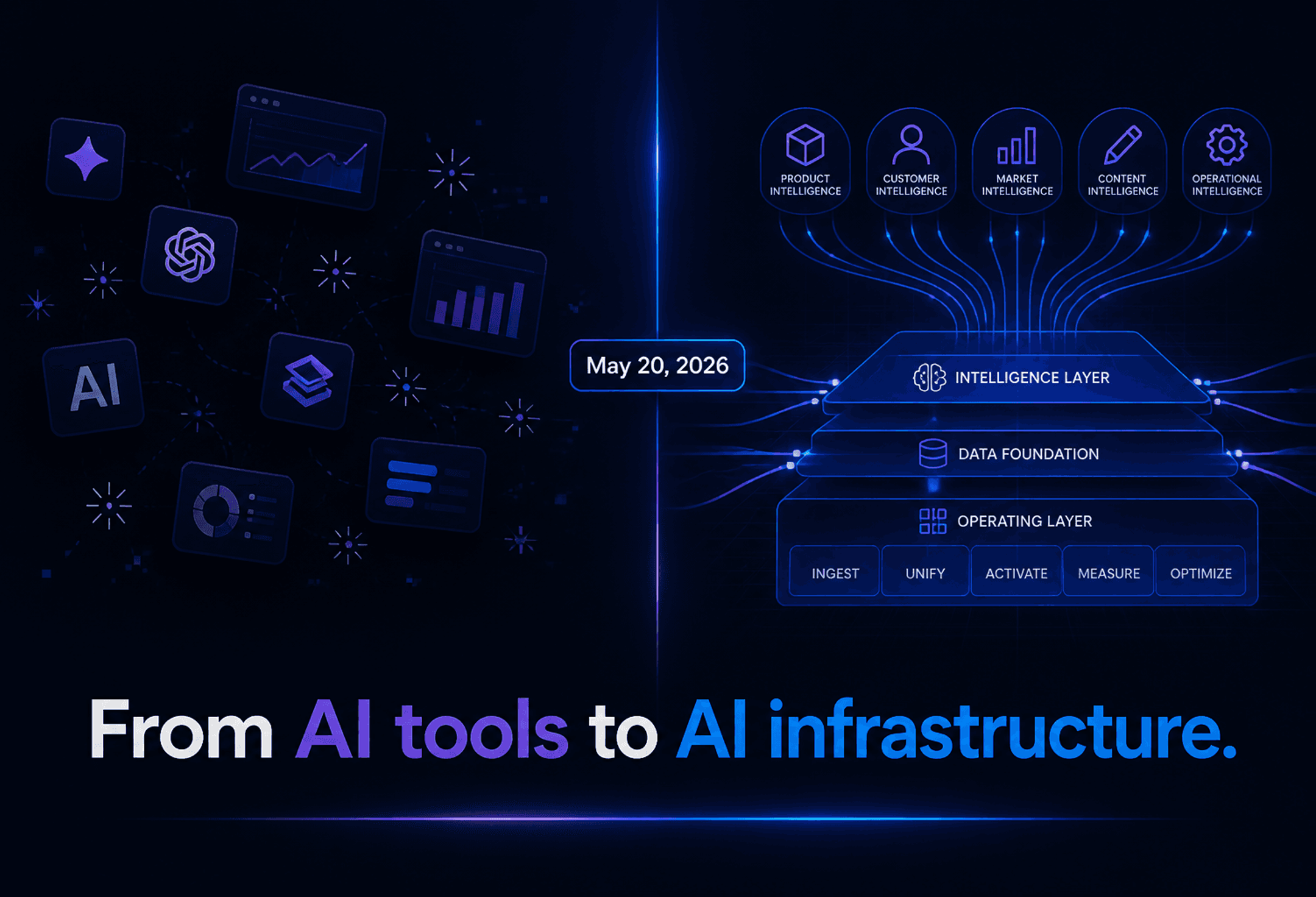
Business Insider called it AI’s “C*VID shutdown moment.”
The comparison is sharp because it is not really about panic. It is about recognition.
During March 2020, the world did not change all at once. The signals had been building for weeks. But one day made the shift impossible to ignore. The businesses that already had digital infrastructure could move. The businesses that did not had to scramble under pressure.
May 20, 2026 may be remembered the same way for AI.
Not because a single product launched. Not because one model got smarter. But because the pattern became visible: AI is no longer an optional layer of experimentation. It is becoming the operating infrastructure underneath how companies learn, decide, create, and act.
For eCommerce brands, that matters more than most operators realize.
Because the question is no longer, “Are we using AI?”
The question is: Is your AI connected, learning, and acting across the business — or is it just another disconnected tool?
The eCommerce Parallel Is Impossible To Ignore
In 2020, brands that already had eCommerce infrastructure were not immune to disruption. But they had a base to operate from.
They had online storefronts. They had digital acquisition channels. They had fulfillment workflows. They had enough customer data to know what was changing and where to respond.
Brands without that infrastructure did not just have a technology problem. They had an operating problem.
The same divide is forming now with AI.
Many brands have added AI features across the stack. A chatbot here. A creative tool there. A reporting assistant inside a dashboard. A workflow automation connected to one channel.
Those tools can be useful. But usefulness is not the same as leverage.
If every AI capability sits inside a separate tool, trained on separate context, disconnected from the full customer journey, the brand does not have intelligence. It has fragments.
That is the 2020 equivalent of saying, “We have a website,” when what the business actually needed was a complete digital operating model.
The next advantage will not come from having more AI tools. It will come from having an intelligence layer those tools can run through.
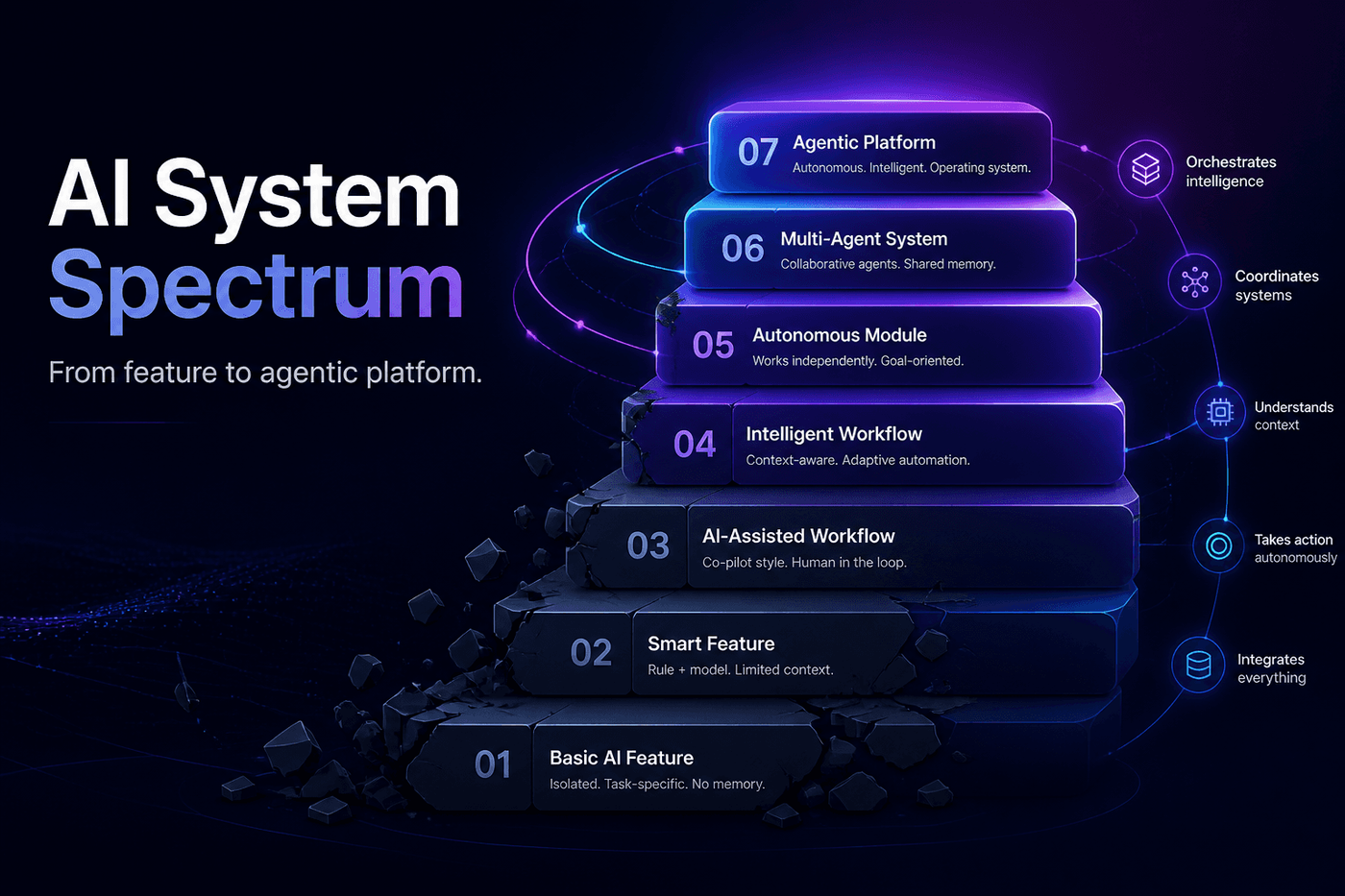
Most Brands Are Lower On The AI Spectrum Than They Think
This is where language matters.
The market uses “AI” to describe almost everything: smart add-ons, wrappers, standalone tools, platforms, AI-native systems, autonomous agents, and full orchestration layers.
Those are not the same thing.
In AccessFuel’s AI System Spectrum, the seven layers move from basic features to full agentic platforms:
- AI Feature: A smart add-on inside an existing product
- AI Wrapper: A new interface on top of someone else’s model
- AI Tool: One job done well, usually in isolation
- AI Platform: Connected tools with shared data
- AI-Native System: Built from the ground up on AI
- Agentic System: AI that can act, not just respond
- Agentic Platform: The orchestration layer where systems perceive, decide, act, and learn
Most eCommerce brands believe they are around Layer 4 or Layer 5.
In practice, many are closer to Layer 2 or Layer 3.
That is not a criticism. It is the natural result of a fast-moving market where every vendor is adding AI language before most brands have a shared vocabulary for what they are actually buying.
But it creates a strategic risk.
Because a brand with ten disconnected AI tools does not have a connected AI system. It has ten separate assistants, each working from a partial view of the business.
That means the creative tool does not understand customer segments. The reporting tool does not understand campaign strategy. The segmentation tool does not understand margin. The support assistant does not understand retention risk. The marketing team still has to connect the dots manually.
That is not agentic AI for eCommerce brands.
That is faster fragmentation.
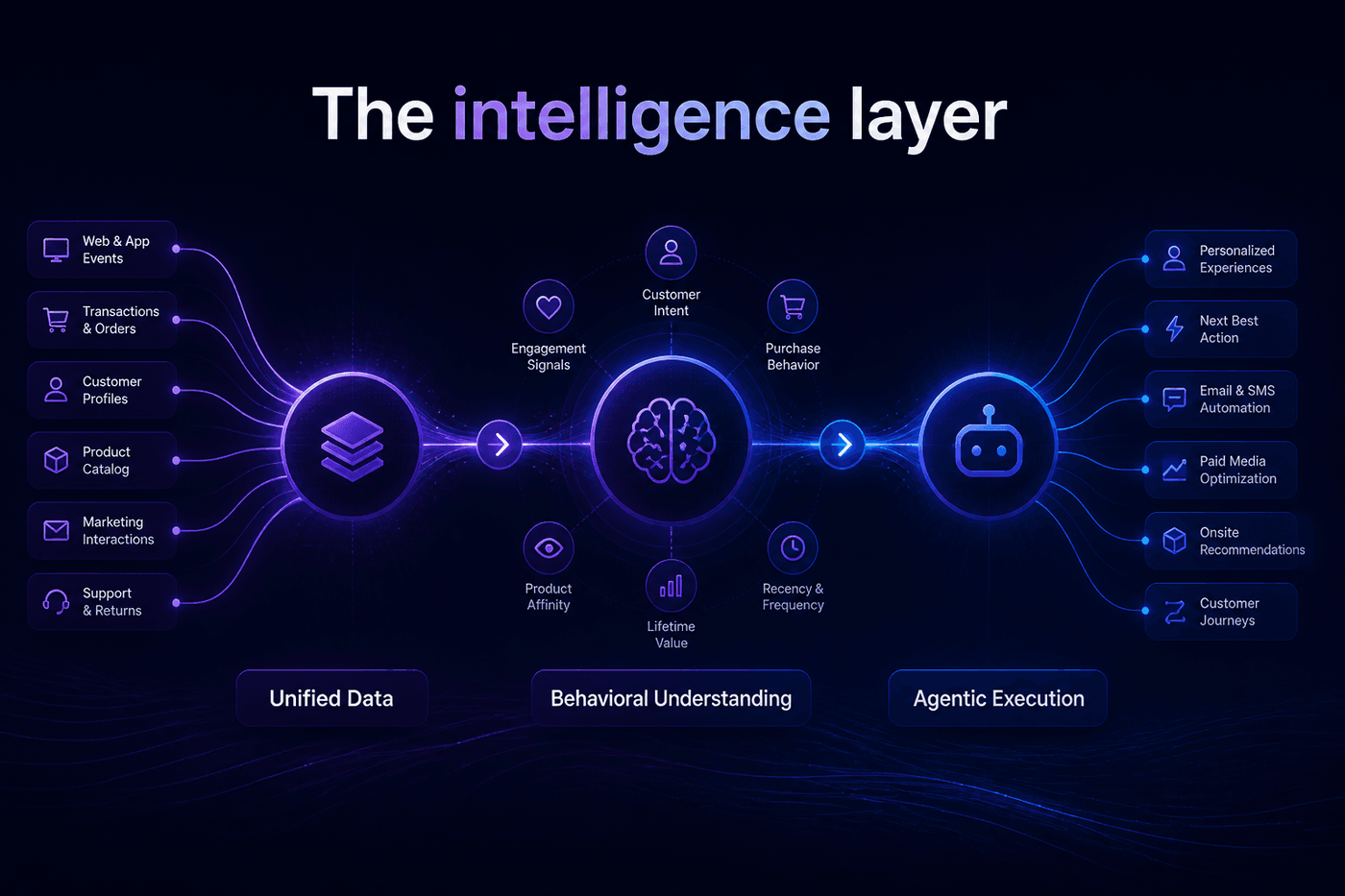
What An Intelligence Layer Actually Means
An intelligence layer is not another dashboard.
It is not buying more AI tools.
It is not adding a chatbot to the site and calling the business AI-ready.
For an eCommerce brand, an intelligence layer means the business has a connected foundation that can understand what is happening across customers, products, orders, campaigns, behavior, and performance — then turn that understanding into action.
At a practical level, it looks like this:
Unified data
Customer, product, order, marketing, and behavioral data need to resolve into one usable view. If the foundation is fragmented, the intelligence will be fragmented too.
Behavioral understanding
The system should understand not just what happened, but who did it, why it matters, and what it suggests about the next best action.
Agentic execution
The system should be able to move from insight to output: building audiences, generating campaign concepts, recommending offers, surfacing risks, and helping teams act with precision.
That is the shift from AI as a feature to AI as infrastructure.
The brands that build this layer will compound. Every campaign teaches the system. Every audience becomes sharper. Every customer signal improves the next decision.
The brands that do not will still be busy. They will still run campaigns, test tools, analyze dashboards, and produce content. But the work will remain manual, disconnected, and slower than competitors whose systems are learning with every move.
The Choice Facing Every Brand Now
The Business Insider framing matters because it captures a broader truth: some moments do not create change. They reveal that the change has already arrived.
May 20 did not make AI important.
It made the cost of waiting clearer.
For eCommerce operators, the next 12 months will separate brands that use AI from brands that operate through AI.
One group will keep layering tools onto fragmented data.
The other will build connected intelligence across the business.
That second group will not just move faster. They will learn faster. They will see patterns earlier. They will build audiences with more precision. They will create campaigns from a clearer understanding of customer behavior. They will stop asking teams to manually translate every signal into every action.
This is the real strategic question:
What does your brand look like 12 months from now if you do not have an intelligence layer?
Not a chatbot. Not a few AI-enabled tools. Not another dashboard.
A connected system that can understand, create, and act.
That is where the market is moving.
You either build your intelligence layer now — or watch your competitors build theirs.
If you want the vocabulary to assess where your current stack sits, start with The AI System Spectrum. It gives operators a clear framework for understanding the difference between AI features, AI tools, AI-native systems, and agentic platforms.
The question is not whether AI belongs in your business anymore.
The question is what layer of the business it belongs in.
Related posts
Keep Exploring
Discover more insights, strategies, and updates from AccessFuel.

4 min read
Data & AnalyticsIs Ecommerce Analytics Consulting Worth It, or Are You Buying a Deck That Goes Stale?
Consulting is worth it when the work is genuinely one-time, and stops being worth it the moment you need the same answer next month. An honest three-way comparison.
4 min read
Customer IntelligenceWhy Does One Buyer Look Like Five People?
One customer, five systems, five different versions of her. Customer data integration is what turns those blind systems into one that can see, and getting it wrong breaks everything downstream.

4 min read
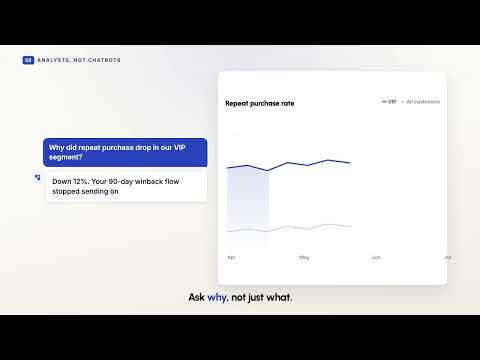
Customer IntelligenceCustomer Intelligence: Why Can't 30 Tools Answer One Simple Question?
Most ecommerce brands run 30 or more tools and still cannot say why repeat purchases dropped last month. Customer intelligence is the layer that closes the gap between them.