Your Data is Talking, But You’re Not Listening
The ecommerce teams of 2026 don't have a data problem. They have a visibility problem.
The answers are usually in there somewhere. Revenue by channel. LTV by acquisition source. AOV trends by customer type. Segments that are quietly outperforming. Campaigns that look good on the surface but fall apart when you look at retention.
It’s all there.
The problem is getting to it without turning your Monday morning into a scavenger hunt.
You know the routine.
Open Shopify. Pull last week’s sales. Check Klaviyo. Open GA4. Compare what happened in Meta. Export a CSV. Add another tab to the spreadsheet that was supposed to be temporary six months ago. Build a chart. Realize two numbers don't match. Start questioning everything.
And by the time you finally get something that looks like an answer, the original question has already gone stale.
That isn't intelligence.
That’s admin work wearing a blazer.
Dashboards were supposed to fix this
Dashboards promised clarity.
And to be fair, they helped. They gave operators a place to see the usual metrics. Revenue. AOV. CAC. ROAS. Conversion rate. Email performance. Traffic trends.
Helpful? Absolutely.
Enough? Not anymore.
Because most growth questions don't fit neatly inside a prebuilt dashboard tile.
A dashboard can tell you what happened.
But operators don't just need to know what happened. They need to know why it happened, who drove it, what changed, which customers matter, and what to do next.
That’s where dashboards start to feel a little like a vending machine.
You can only pick from the buttons someone already gave you.
But real business questions are messier than that.
Questions like:
“What was my AOV for returning customers last quarter?”
“Which acquisition channels brought in customers with the highest LTV?”
“Which customers bought during our last launch but haven't purchased again?”
“What’s the LTV of customers acquired through Facebook who opened at least three Klaviyo emails?”
That last one is where the old workflow breaks.
Shopify alone can't answer it.
Klaviyo alone can't answer it.
GA4 alone can't answer it.
Meta alone can't answer it.
The answer lives across all of them.
Which means your team either has to stitch it together manually, wait for an analyst, or simplify the question until it fits inside a tool that was never built to answer it.
That’s the part nobody talks about enough.
Your tools don't just shape your reporting.
They shape your curiosity.
The question is the interface now
This is where AIRA changes the workflow.
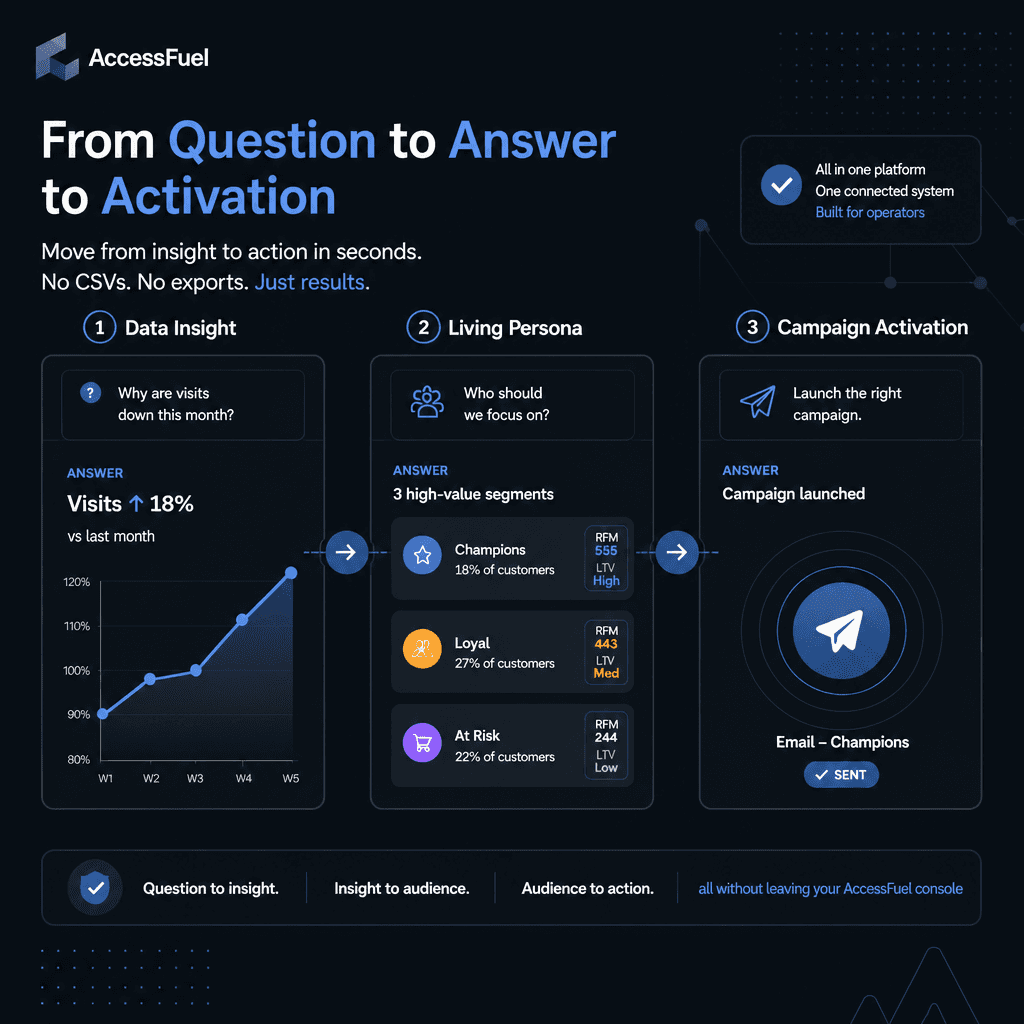
Instead of forcing your team to think in exports, filters, dashboards, and spreadsheet formulas, AIRA lets you ask your business a question in plain English.
You ask: “What was my revenue by channel last month?”
AIRA returns the answer with a chart.
You follow up: “Break that down by new vs returning customers.”
AIRA updates the analysis.
You ask: “Which customer segment had the highest repeat purchase rate?”
AIRA finds it.
You ask: “Create a segment of customers who bought Product A, spent more than $250, and haven’t purchased in 90 days.”
AIRA turns that into an audience you can actually use. That’s the shift.
You’re not clicking around a reporting tool hoping to land on insight.
You’re having a conversation with your data.
And with the latest AccessFuel console upgrade, powered by GPT 5.5, that conversation feels more natural, more capable, and more useful than ever.
AIRA can better understand layered questions. It can keep context as you dig deeper. It can move from high-level performance to customer-level action without making you start over every time.
So instead of asking one rigid question, waiting for a report, then rebuilding the next one from scratch, your team can follow the thread.
Start broad. Get specific.
Find the pattern. Build the segment.
Take action.
That’s how operators actually think. Now the software can keep up.
Better answers start with better context
Talking to your data only works if the data is ready to answer.
That’s why AccessFuel doesn't just connect to your tools. It unifies and enriches the data behind them.
AIRA can work across sources like Shopify, Klaviyo, GA4, and paid media platforms so your questions don't have to stay trapped inside one system at a time.
Then AccessFuel adds intelligence your source platforms don't naturally give you on their own.
Things like:
LTV calculations
RFM scoring
Cohort analysis
Customer behavior patterns
Purchase recency and frequency
High-value customer identification
Segment opportunities
Campaign and revenue performance context
That enrichment matters because raw data is only part of the story.
Knowing someone placed an order is useful.
Knowing they’re a high-value returning customer who came from a specific channel, opened multiple emails, bought during a launch, and is now slipping into churn risk is much more useful.
That’s not a report.
That’s a growth opportunity.
This is bigger than faster reporting
Yes, AIRA can save time.
That part is easy to understand.
No more weekly spreadsheet rituals. No more jumping between tabs. No more waiting three days for a question that mattered yesterday.
But the bigger value is what happens after reporting gets easier.
Teams ask more questions.
And when teams ask more questions, they find more opportunities.
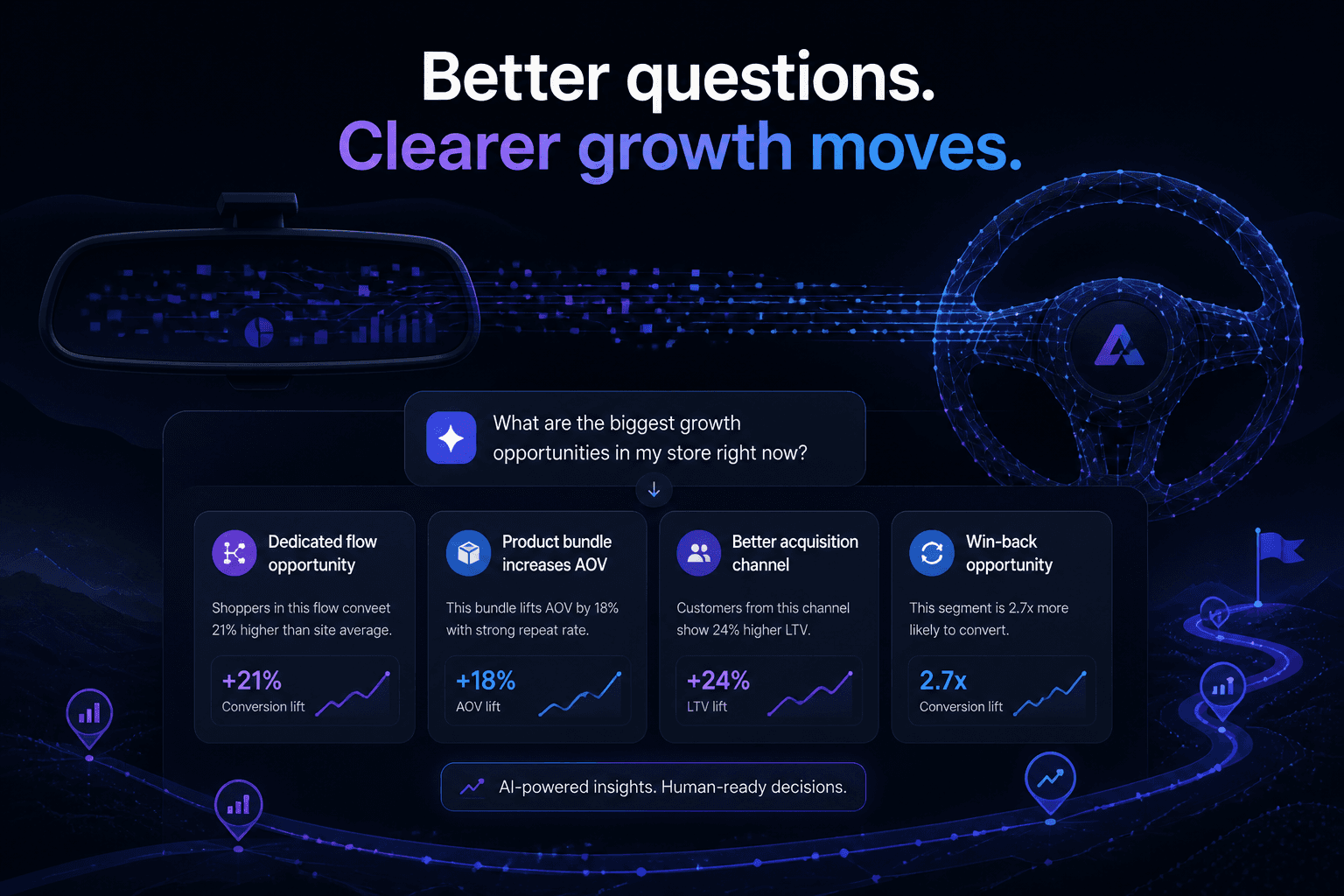
They spot the segment that deserves a dedicated flow.
They catch the product bundle that quietly increased AOV.
They notice that one acquisition channel drives cheaper customers, but another drives better ones.
They find the customers worth winning back before those customers disappear.
They stop treating data like a rearview mirror and start using it like a steering wheel.
That’s the real unlock.
Not just faster answers.
Better questions.
More confident decisions.
Clearer growth moves.
The old way made insight feel expensive
For a long time, advanced analytics felt like something only bigger teams could access.
If you had analysts, engineers, custom dashboards, and enough time, you could ask deeper questions.
If you didn't, you stayed closer to surface-level reporting.
Revenue went up.
ROAS went down.
Email drove sales.
Returning customers spent more.
All true. All useful. Also incomplete.
The next generation of ecommerce operators won't win because they have more dashboards.
They’ll win because they can move from question to answer to action faster than everyone else.
That’s what the upgraded AccessFuel console is built for.
It gives operators a more natural way to work with data, powered by a smarter AI experience that can handle the complexity behind the scenes.
Ask the question. See the answer. Drill deeper.
Build the audience. Move.
No SQL. No CSV maze. No dashboard gymnastics.
Just a clearer path from curiosity to action.
Your data isn't silent
Your data has been telling a story this whole time.
The issue is that most teams have been forced to read it through exports, dashboards, and disconnected tools.
AIRA gives you a better way in.
Ask what happened, why it happened, who drove it, and what to do next.
The brands that get good at this will have an advantage that compounds.
Because curiosity compounds.
Every better question creates a better decision. Every better decision creates a sharper campaign, smarter audience, cleaner offer, stronger retention play, or more confident growth move.
Your data isn't silent. You just needed a better way to talk to it.
Learn more or book a demo when you’re ready at AccessFuel.com