Growth & Performance
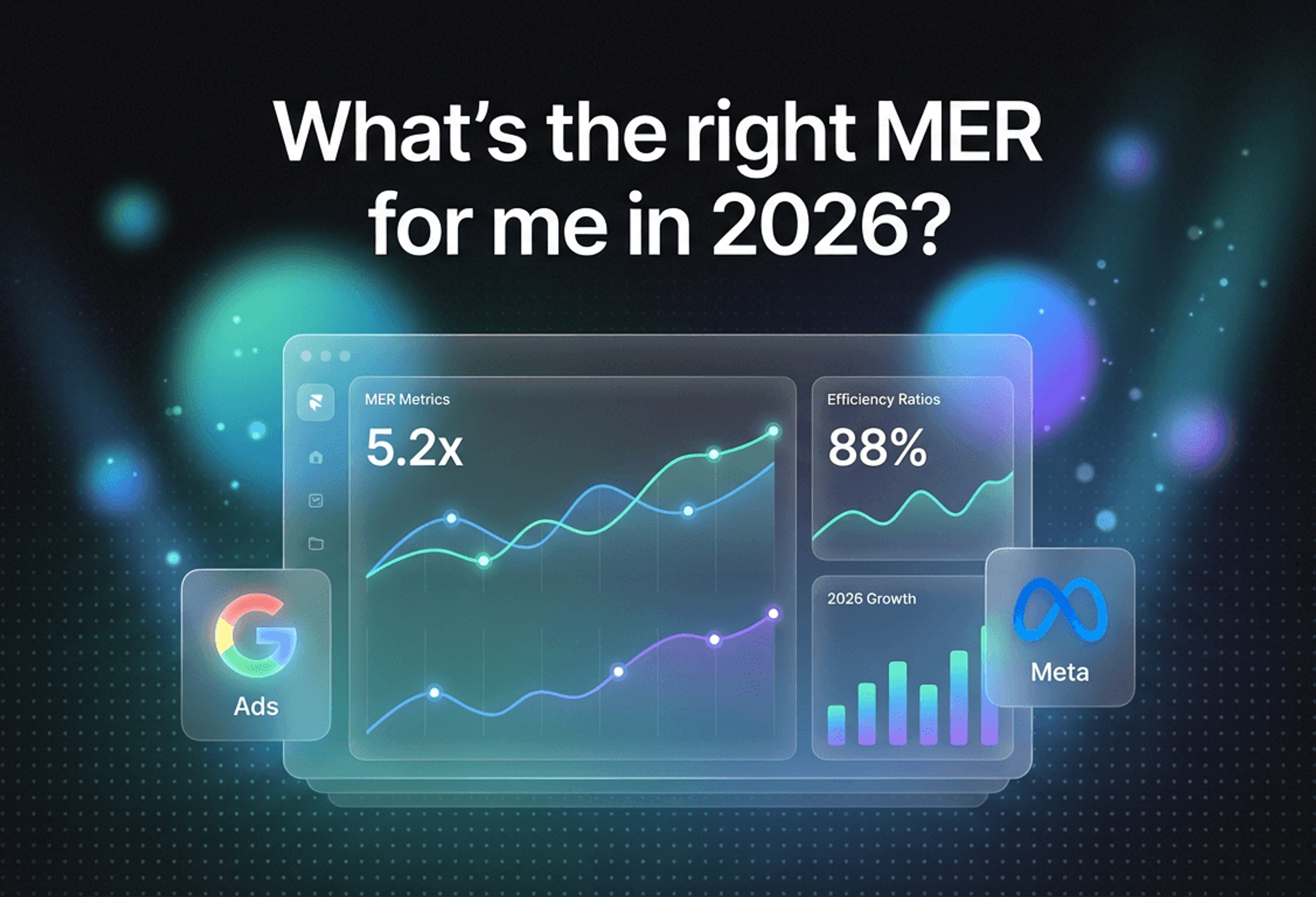
What's the right MER (Marketing Efficiency Ratio) for me in 2026?
Your ROAS looks great. Your blended numbers tell a different story. Here's how to read the one metric that actually reflects reality.
- Published
- Author
- AccessFuel Team
- Reading time
- 5 min read
If you run an ecommerce brand right now, you've probably had this exact moment.
You're staring at a dashboard full of numbers — ROAS on one tab, CAC on another, blended CPAs scattered across three platforms — and none of it adds up. One channel says you're killing it. Another says you're bleeding cash. Your CFO asks a simple question: "Are we actually making money on marketing?" And you're not sure how to answer.
That's the problem MER solves. And it's why more operators are making it their north star heading into 2026.
What Is MER?
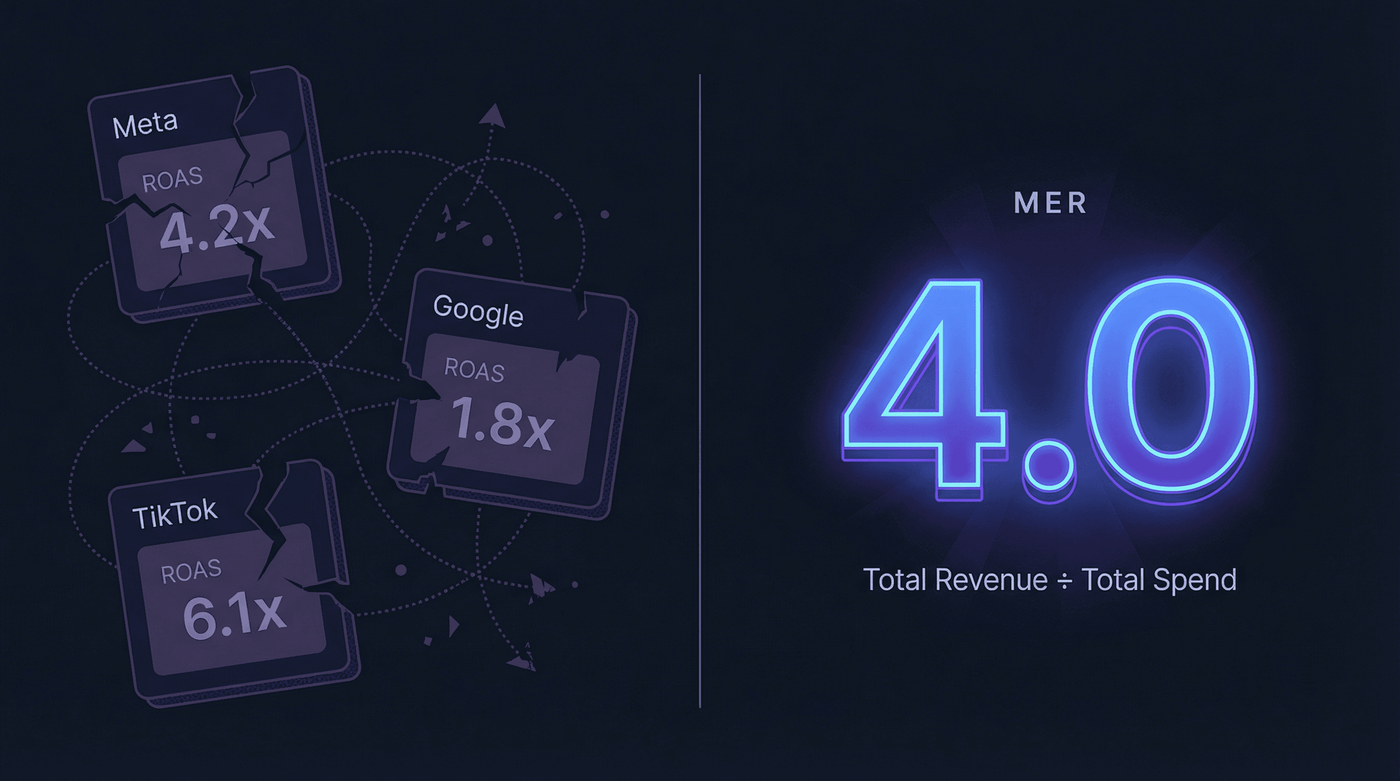
Marketing Efficiency Ratio (MER) = Total Revenue ÷ Total Marketing Spend
No channel breakdowns. No first-touch vs. last-touch debates. No UTM dependency. You spent $50,000 on marketing last month and brought in $200,000 in revenue? Your MER is 4.0.
It's the cleanest read you'll get on whether your overall marketing engine is doing its job.
What's a Good MER in 2026?
Your ideal MER depends on your margins, growth stage, and category. But here's a practical benchmark framework for ecommerce brands this year:
| MER Range | What It Signals |
|---|---|
| Below 3.0 | Spending more than you should per dollar of revenue. Not always a crisis (launch-phase burn, for example), but a signal that something needs attention. |
| 3.0 – 5.0 | Healthy range for most brands doing $1M–$20M annually. Enough return to sustain growth without cash bleed. |
| Above 5.0 | Strong. Your marketing is efficient and organic momentum — repeat buyers, brand pull — is working alongside paid. |
| Above 8.0 | Exceptional. Word of mouth, community, or content is doing significant lifting. Rare — and worth protecting. |
One important caveat: A sky-high MER isn't always a green light. If you're at 10.0 but revenue has flatlined, you may just be underspending. MER is a ratio, not a growth metric. Context always matters.
Why MER Over ROAS?
ROAS tells you what a specific channel returned. That's useful — but it's also where attribution headaches live.
Did that Meta campaign actually drive the purchase? Or did the customer see a TikTok, Google your brand, and then click a retargeting ad? ROAS tries to assign credit. MER doesn't bother. It just asks: did the whole machine work?
Think of it this way — channel metrics are the individual dials on your dashboard. MER is the fuel gauge. You need both. But if you can only glance at one while you're driving, you want the fuel gauge.
The Three Levers That Actually Move MER
You don't need to spend more to improve your MER. These three levers work on the revenue side of the equation:
1. Average Order Value (AOV)
More revenue per order without proportional ad spend increase. Bundles, upsells, and smart product architecture all push AOV up — and your MER with it.
2. Repeat Purchase Rate
A customer who buys twice on one acquisition cost is twice as efficient. Email, SMS, loyalty programs, and genuine product quality all drive retention. The brands running the highest MERs almost always have strong repeat purchase engines.
3. Conversion Rate
More visitors converting means your spend stretches further. Site experience, product pages, and landing page relevance all live here.
None of these three levers require you to increase your ad budget. That's the real insight.
The Piece Most Brands Miss
The brands consistently running above a 5.0 MER aren't just running smarter campaigns. They know their customers with real depth.
Not just demographics. They understand what motivates the purchase, what hesitation looks like before someone bounces, and which message lands with which segment. That kind of intelligence turns every dollar of spend into a sharper bet. You stop guessing which creative to run, which offer to lead with, which audience to prioritize.
Your MER improves because your decisions improve.
That's the part most benchmarking articles skip. The number is just an output. The input is how well you understand the people you're selling to.
Key Takeaways
- MER = Total Revenue ÷ Total Marketing Spend — the cleanest read on your overall marketing efficiency
- For most ecommerce brands in 2026: 3.0–5.0 is healthy, 5.0+ is strong, 8.0+ is exceptional
- Improve it by raising AOV, increasing repeat purchases, and converting more visitors
- The real unlock is customer intelligence — knowing your audience well enough to make every dollar count before it's spent
FAQ
What is a good MER for a DTC ecommerce brand?
For most DTC brands doing $1M–$20M in annual revenue, a MER between 3.0 and 5.0 is considered healthy. Above 5.0 signals strong efficiency; above 8.0 is exceptional and typically indicates significant organic or retention momentum.
How is MER different from ROAS?
ROAS measures the return on a specific channel's ad spend. MER measures the return on your total marketing spend across all channels — making it a cleaner, attribution-free view of overall marketing performance.
What's the fastest way to improve my MER?
Focus on the revenue side: increase average order value through bundles or upsells, improve repeat purchase rates through email and retention programs, and convert more of your existing traffic. These moves improve MER without increasing your ad budget.
Can my MER be too high?
Yes. A very high MER with flat revenue may indicate you're underspending — leaving growth on the table. MER is a ratio, not a growth signal. Always read it alongside revenue trajectory and market opportunity.
About AccessFuel
We build AI-native tools that help ecommerce brands understand their customers at a deeper level — so every growth decision, from acquisition to retention, is grounded in real intelligence. Learn more at accessfuel.com
Related posts
Keep Exploring
Discover more insights, strategies, and updates from AccessFuel.
4 min read
Customer IntelligenceWhy Does One Buyer Look Like Five People?
One customer, five systems, five different versions of her. Customer data integration is what turns those blind systems into one that can see, and getting it wrong breaks everything downstream.

4 min read
Customer IntelligenceCustomer Intelligence: Why Can't 30 Tools Answer One Simple Question?
Most ecommerce brands run 30 or more tools and still cannot say why repeat purchases dropped last month. Customer intelligence is the layer that closes the gap between them.

5 min read
Customer IntelligenceCustomer Segmentation: Which of Your Loyalists Are About to Leave?
About one in five of your loyal customers are quietly slowing down. Shopify can confirm they exist. It will not tell you which ones are worth saving. RFM segmentation does.