Growth & Performance
What's the right balance between acquisition spend and retention investment?
Most brands pick a side. The ones that win build a system. Every growth conversation eventually arrives at the same fork in the road. Do we spend more to acquire new customers, or do we invest more in keeping the ones…
- Published
- Author
- AccessFuel Team
- Reading time
- 7 min read
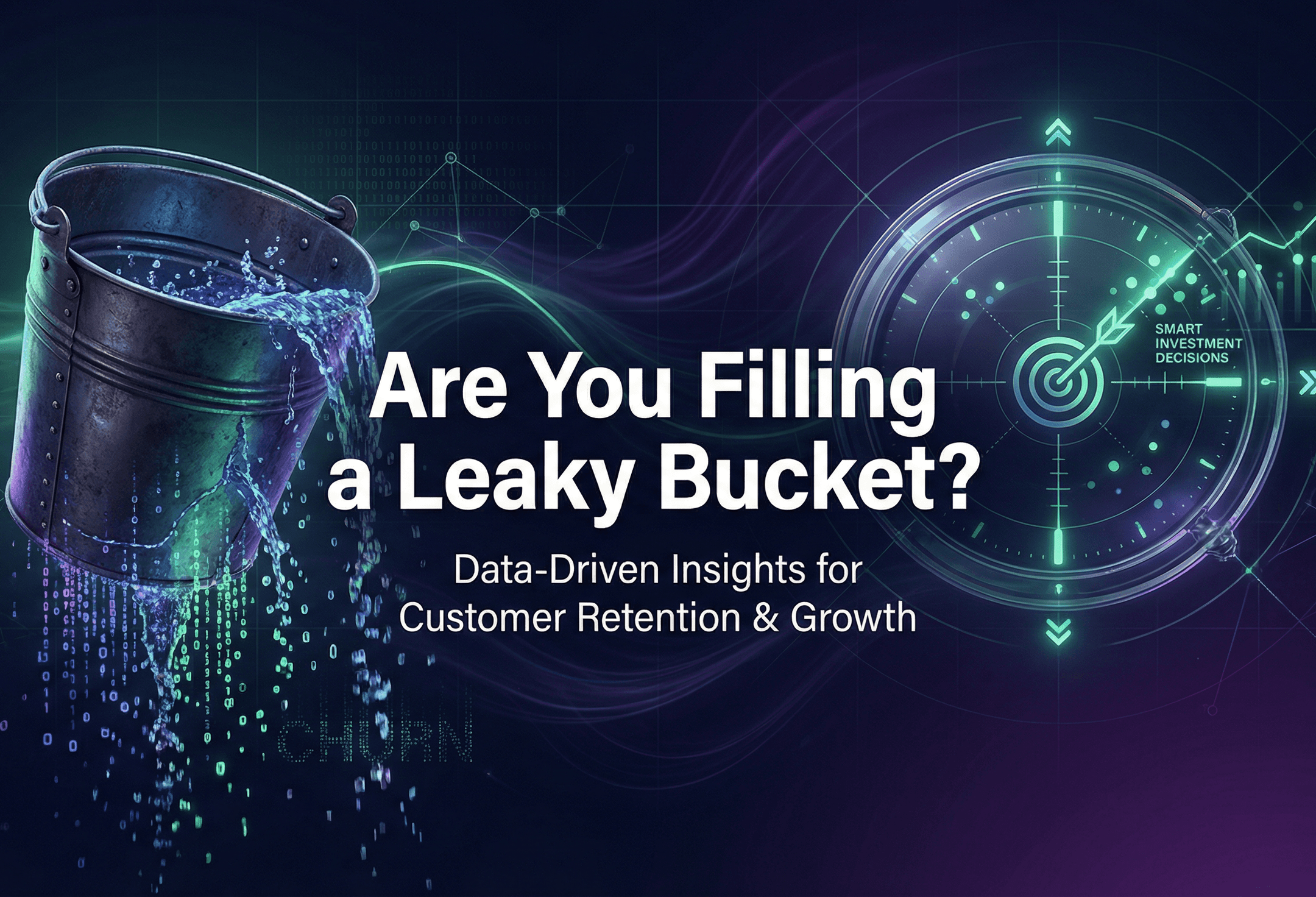
Most brands pick a side. The ones that win build a system.
Every growth conversation eventually arrives at the same fork in the road.
Do we spend more to acquire new customers, or do we invest more in keeping the ones we have?
The framing itself is the problem.
That question treats acquisition and retention as competitors for the same budget, when they are actually two phases of the same engine. One fills the funnel. The other determines whether the funnel generates compounding returns or just cycles through customers who never come back.
The brands that scale with precision do not choose one over the other. They understand when to weight each, and they use customer data to make that call with clarity rather than instinct.
Here is the framework.
Why This Question Does Not Have a Universal Answer
There is no magic ratio. No rule that says "spend 60% on acquisition, 40% on retention" that applies across every brand, category, and growth stage.
What there is: a set of signals your own data is already sending that tells you exactly where to weight your investment.
The problem is that most brands are not reading those signals correctly. Or at all.
Acquisition spend is loud. It has real-time feedback loops, clickthrough rates, ROAS dashboards, and daily spend reports. Retention is quieter. Repeat purchase rates are checked monthly. LTV reports are pulled quarterly, if at all. Churn goes unnoticed until revenue stalls.
So brands default to acquisition because it feels like action. And retention gets the scraps.
This is not a strategy. It is a reflex.
The Leaky Bucket Problem
Imagine you are filling a bucket with water. Acquisition is the faucet. Retention is the seal on the bucket.
If you pour water in faster than it leaks out, you appear to be growing. But the moment you turn down the faucet, you realize the bucket was never actually holding water. It was just moving through.
This is what over-indexed acquisition spend looks like on a balance sheet: strong top-line numbers, thin cohort retention, fragile revenue that collapses the moment paid media gets expensive or the algorithm shifts.
The fix is not to stop acquiring. It is to fix the leak before you pour in more.
That requires knowing: who are your retained customers? Why do they come back? What behavior signals, in the first 30 to 90 days, predict a customer's likelihood of returning?
These are not intuition questions. They are data questions.
The Cohort Maturity Signal
Your acquisition-to-retention ratio should not be static. It should shift as your brand matures.
Early-stage brands (Year 0 to 2): Acquisition should dominate. You are building a customer base from zero. Retention investment on a thin cohort produces minimal compounding. Fill the bucket first.
Growth-stage brands (Year 2 to 5): This is where the balance starts to matter. You have enough cohort data to understand which customers actually return, what their LTV ceiling looks like, and which acquisition channels bring in customers who behave like your best buyers. This is the stage where retention investment starts to compound.
Scale-stage brands ($20M and up): Retention should become a primary growth lever. Your CAC is rising. Paid media is getting more competitive. The brands winning at this stage are the ones who have built loyalty infrastructure around a deeply understood customer base. Acquisition becomes more targeted and efficient because they know exactly who they are looking for.
If you are a growth-stage brand still spending like it is year one, you are leaving compounding returns on the table.
The LTV Threshold Rule
Here is the question most brands skip: what is the ceiling on your retained customer's value?
Because not all retention is worth the same investment.
If your average one-time buyer spends $60 and your retained customer spends $420 over three years, a loyalty investment that costs $30 per customer to execute has a wildly different ROI than if those numbers were $60 and $90.
Retention investment only makes sense at scale when you understand the LTV ceiling of the customers you are trying to retain. If your repeat buyers have high LTV and low churn after the second purchase, a relatively modest retention investment produces massive returns. If your product is genuinely low-frequency, over-investing in retention against customers who were never going to come back is just another form of waste.
The decision is mathematical. The data is already there. Most brands just are not looking at it precisely enough.

What Precision Looks Like in Practice
The brands that get this right share one thing in common: they know their customers.
Not demographics. Not "women 25 to 44 interested in wellness." That is audience targeting, not customer clarity.
Customer clarity means knowing: what motivates your highest-LTV customers to buy again? What channels did they first come through? What was their first product? What did their purchase cadence look like in month one versus month six? What messaging resonates with them versus casual buyers?
When you have this level of persona intelligence, two things happen.
First, your retention investment becomes targeted. You stop running blanket loyalty campaigns and start activating the specific behaviors and messages that drive repeat purchase from the customers who actually respond to them.
Second, your acquisition spend becomes smarter. You stop optimizing for volume and start optimizing for quality. You know what a high-LTV customer looks like before they have made their second purchase. You build acquisition creative and targeting that attracts more of them.
This is not a future capability. It is what data-driven persona intelligence does right now.
A Working Framework for Setting Your Balance
Use these questions as your calibration tool:
1. What is your current repeat purchase rate?
If less than 20% of first-time buyers return within 12 months, retention has a structural problem that no loyalty program will fix without first understanding why customers are leaving.
2. What is the LTV gap between one-time and repeat buyers?
If that gap is 3x or more, retention is your highest-leverage investment. If the gap is narrow, your product or category may simply be low-frequency, and acquisition should remain the primary engine.
3. What is your CAC trend?
Rising CAC is a signal to diversify. Brands that are 100% dependent on paid acquisition are one algorithm change away from a margin crisis. Retention builds owned revenue that does not pay rent to a platform.
4. Do you know which acquisition channels bring in your highest-LTV customers?
If not, you are not optimizing acquisition. You are just spending. The answer to this question is what separates precision marketers from volume buyers.
5. How mature is your cohort data?
If you have less than 12 months of retention data, you are operating on incomplete information. If you have 24 months or more, you have enough signal to make high-confidence investment decisions across both acquisition and retention.
The Bottom Line
The acquisition versus retention debate is a false binary.
The real question is: what does your data tell you about where marginal spend produces the highest return right now, given your brand's stage, cohort maturity, and customer LTV profile?
That answer changes as your brand grows. The brands that stay ahead of it are the ones who treat customer understanding as infrastructure, not an afterthought.
Growth is never an accident. And the brands that balance acquisition and retention well are not guessing. They know their customers.
That is the advantage.
Related posts
Keep Exploring
Discover more insights, strategies, and updates from AccessFuel.
4 min read
Data & AnalyticsIs Ecommerce Analytics Consulting Worth It, or Are You Buying a Deck That Goes Stale?
Consulting is worth it when the work is genuinely one-time, and stops being worth it the moment you need the same answer next month. An honest three-way comparison.
4 min read
Customer IntelligenceWhy Does One Buyer Look Like Five People?
One customer, five systems, five different versions of her. Customer data integration is what turns those blind systems into one that can see, and getting it wrong breaks everything downstream.

4 min read
Customer IntelligenceCustomer Intelligence: Why Can't 30 Tools Answer One Simple Question?
Most ecommerce brands run 30 or more tools and still cannot say why repeat purchases dropped last month. Customer intelligence is the layer that closes the gap between them.